
Marion County 72-Hour Release Reality
Neither Marion County nor North Central Regional Jail and Correctional Facility offers an official released-in-the-last-72-hours feed. No distinct three-day archive, recent-release gallery, or sheriff jail app was verified. Marion does not operate the adult regional jail. WVDCR runs NCRJCF and provides separate jail and prison searches, but neither is a rolling departure report.
The absence matters most over weekends and holidays. Three calendar dates can contain bond authorization, facility processing, a transfer, and later web updates. A current view cannot reconstruct that sequence by itself. The sound method records what each official source displayed at fixed times and then seeks the actual DCR movement entry. It does not scrape names into a substitute list.
Track Marion County Three-Day Releases
Use the same identifiers and observation time each day. A full legal name, birth date, Marion case number, and OID reduce false matches. Save the exact status wording rather than paraphrasing it. The method below creates an evidence log for one person, not a bulk Marion County release list.
- Set the Eastern Time interval and mark three observation points that cover it.
- At each point, search the WVDCR regional-jail OIS and save the matching facility and status.
- Repeat the search on the WVDCR prison OIS to detect a jail-to-prison transfer.
- Check VINELink for the same identity and record its reporting agency, custody status, and dates.
- Review Marion magistrate and circuit dockets for orders entered during the interval.
- Call NCRJCF if the observations conflict, then request the existing movement or release record for a lasting answer.
A person present on the jail side on day one and absent on day two did not automatically leave for the community on day two. A prison match may resolve the change as transfer. A VINE notice after arrival elsewhere may do the same. A court release order paired with an actual DCR release entry supports a community-release conclusion.
Marion Three-Day Observation Fields
There is no official 72-hour output with release fields. Build the comparison from sources that actually exist. Label every item by evidence type so a scheduled date, legal order, and physical movement are not treated as one event.
| Observation field | How to use it |
|---|---|
| Date, time, and source | Fixes when each web or agency observation was made. |
| Name, DOB, OID, case | Confirms that all three observations concern the same person and custody episode. |
| Jail match and facility | Records whether OIS reported regional-jail custody at that moment. |
| Prison match and facility | Tests whether a missing jail result became a state-prison entry. |
| VINE status and agency | Adds a custody-change and notification source, subject to lag and transfer rules. |
| Court order | Explains bond, dismissal, sentence, time served, or another legal basis. |
| DCR movement entry | Provides the actual release or transfer event, type, date, and destination if maintained. |
The Daily Incarcerations tool has intake-oriented fields such as time, name, birth date, gender, detail access, and a total. Those fields document admission. They cannot be recast as a Marion County 72-hour release record.
No public retention interval fills that gap. The fact that a result remained visible, changed, or vanished between observations does not supply an actual departure time. Preserve the change as evidence, then verify its cause.
Marion Weekend Release Observations
State magistrate procedure provides an on-call magistrate for specified criminal duties outside normal hours, including initial appearances and taking bond. That permits legal work to move after hours. It does not create a fixed NCRJCF release schedule or guarantee that a person will leave on the date bond is posted.
Weekend and holiday checks should separate the time of a court action from facility processing. Other holds, identity review, property handling, or transportation can affect departure. The lack of a fresh web result may also be an update issue. Extend the log through the next normal business period when the sources remain unclear, then call NCRJCF rather than assigning a release date from silence.
The Marion County 24-Hour Releases method is a tighter same-day check. Use the three-day method when the interval crosses several dates or when a single snapshot did not resolve movement.
Note: No published NCRJCF release door, family waiting area, holiday departure schedule, or guaranteed weekend processing time was found.
Request Marion 72-Hour Release Proof
A focused WVDCR records request is the archive fallback. Identify the named person, date of birth or OID, NCRJCF, and the defined three-day custody period. Request existing admission, movement, actual release date and time if maintained, legal release authority or type, destination or receiving agency, and any revised sentence-calculation record relevant to the movement. Ask for electronic, segregable nonexempt portions.
West Virginia FOIA requires reasonable specificity and generally gives a public body five working days to provide the requested information, advise when and where it will be available, or deny in writing with reasons. Weekends and legal holidays are excluded from that response calculation. The deadline is not a promise that a large production will be complete. A narrow person-and-episode request is more useful than asking DCR to create a list it may not maintain.
Use the Marion court clerk for signed bond, dismissal, sentencing, revocation, or discharge orders. Use the sheriff for arrest or report records that office created. NCRJCF and WVDCR remain the custodians for regional-jail movement and release facts. The Marion County released inmate lookup covers the named-person search path when the original facility is unknown.
Why Marion Release Data Disappears
WVDCR states that its public information changes quickly and may not show the true current location, release date, or status. It publishes no official retention promise for a former NCRJCF entry. Therefore, the hour when a name vanishes cannot be converted into the hour of release. It also cannot distinguish data cleanup from custody movement.
This is Marion County's key roster quirk. The regional jail is a state facility that serves eight counties, while WVDCR separates jail and prison records. A person may leave the North Central result and enter the prison system after sentencing. The same physical complex name also includes “Correctional Facility,” but the legal custody path still must be checked on the correct side of OIS.
A dated screen capture is useful as an observation. It is not a certified historical release list. Preserve the query, access time, match identifiers, exact displayed text, and source. Later compare those facts with the court order and DCR record rather than relying on a stale cache.
VINE in Marion Release Tracking
West Virginia VINE covers all state regional jails and WVDCR prisons, including NCRJCF. It is useful during a three-day interval because a custody status or notification can supply an additional dated observation. Search one person, compare identity details, and record the exact reporting facility and status.
DCR intentionally does not make a VINE call while a person is being transferred. Notice follows arrival. A quiet period between facilities therefore must not be read as release. VINELink also does not cover BOP, ICE, or U.S. Marshals custody. A state handoff to a federal agency requires the appropriate federal locator or court record.
The VINELink West Virginia selection screen shows the official starting point for the person-level check.
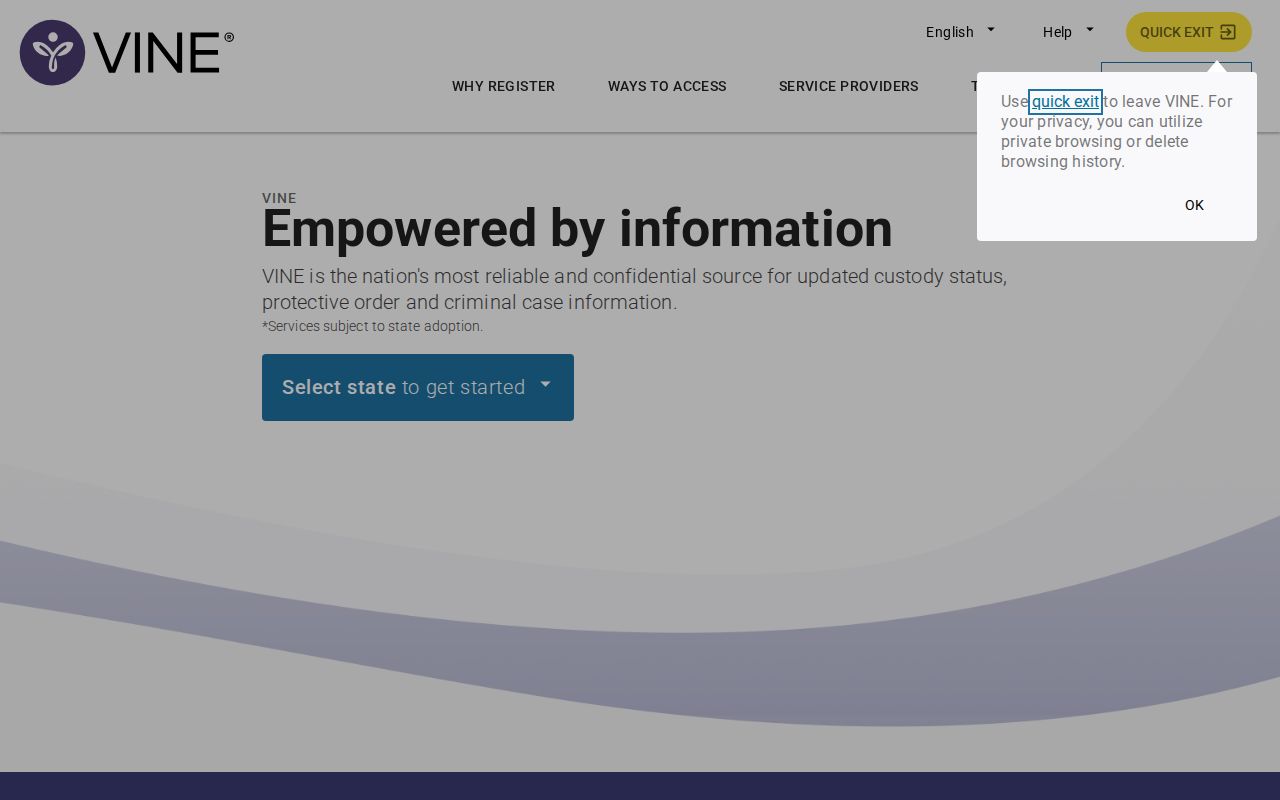
That screen begins an individual custody-status search, not a public list of everyone released from Marion County across three days.
Classify Marion Three-Day Movements
The final classification changes what to check next. Bond or recognizance may end jail custody while the Marion criminal case continues. Time served can satisfy the custody portion, yet probation or other court duties may remain. Parole is physical release under continuing WVDCR supervision. Final discharge means the identified sentence or supervision has ended, but another case could still exist.
A transfer is different. Movement to a WVDCR prison, another jail, ICE, or the U.S. Marshals Service ends the NCRJCF entry without producing community release. Use the destination field and receiving-agency record. If the DCR record only says court-order release, obtain the signed order to determine whether it reflects bond, dismissal, time served, or another ground.
- Observation
- What a system displayed at a recorded time.
- Legal disposition
- A court act that explains authority, but not always physical departure.
- Movement
- The facility event that records release or transfer.
- Discharge
- The end of the sentence or supervision specifically identified in the record.
Note: Keep the three dates in the log even after the event is resolved because they document the sequence and any display lag.