
Marion Scheduled and Actual Release
The safest official West Virginia term supported by WVDCR policy is “minimum discharge/final release date.” Policy 454.10 defines it as the scheduled sentence release if incarceration continues without lost good time. It is a computation. It is not a gate appointment, a promise of parole, or proof that another agency will not take custody.
A person awaiting trial at North Central Regional Jail and Correctional Facility has no computed sentence endpoint. Bond may be set, a judge may enter a release order, or another hold may keep the person in custody. A sentenced jail inmate may receive time-served credit, while a state prisoner’s date is calculated within WVDCR. Those paths require different records.
Marion County has no standalone sheriff jail roster. NCRJCF is state-run and OIS separates jail from prison results. A name that leaves the jail search may have moved to prison. Search both before calling the change a release.
Find Marion Projected Release Dates
Start with full name, date of birth, OID, case number, and sentencing county. The direct prison application was blocked during research, so no exact public date-field label is promised. Capture whatever label the live record uses and note the access date.
- Use the WVDCR Offender Search gateway. Check the jail side if the custody began at NCRJCF, then use the prison side for a state sentence.
- Open the correct match by comparing name, OID, date of birth, facility, and case details. Do not rely on name alone.
- Record the precise sentence or date label and value. Do not rename it “projected” if OIS calls it something else.
- Read the Marion sentencing order through WVPASS or MCR Search. Obtain the signed order from the clerk when the docket abbreviates credit or sentence terms.
- Ask WVDCR for the current calculation or time sheet, including jail credit and later revisions.
- After departure, request the actual movement or release entry to learn whether the event was discharge, parole, conditional supervision, or transfer.
The Marion County release-record path shows how court, OIS, VINE, and records-request evidence should be reconciled when results conflict.
West Virginia Good-Time Calculation
West Virginia Code §15A-4-17 supplies the main statewide good-time rule. Eligible adults in the Commissioner’s custody earn one day of good time for each day incarcerated, including qualifying presentence jail days credited by the court. The credit reduces the maximum indeterminate or fixed determinate term. Consecutive maximum terms are combined for this calculation.
Life sentences earn no good time. Credit also does not accrue while the person is on parole, bond, or otherwise outside physical incarceration. Discipline can cause forfeiture, and Commissioner approval can restore credit. The statute allows limited awards for meritorious or emergency duties and up to 90 days for eligible felony inmates who complete approved, nonrequired academic or vocational programs.
There is no general West Virginia rule requiring every state prisoner to serve about 85 percent. Federal shorthand and another state’s rule do not belong in a Marion release calculation. Offense-specific minimums, parole limits, sentence structure, and statutory exclusions can still change how long a person must serve.
The official good-time statute is shown in the matching research image below.
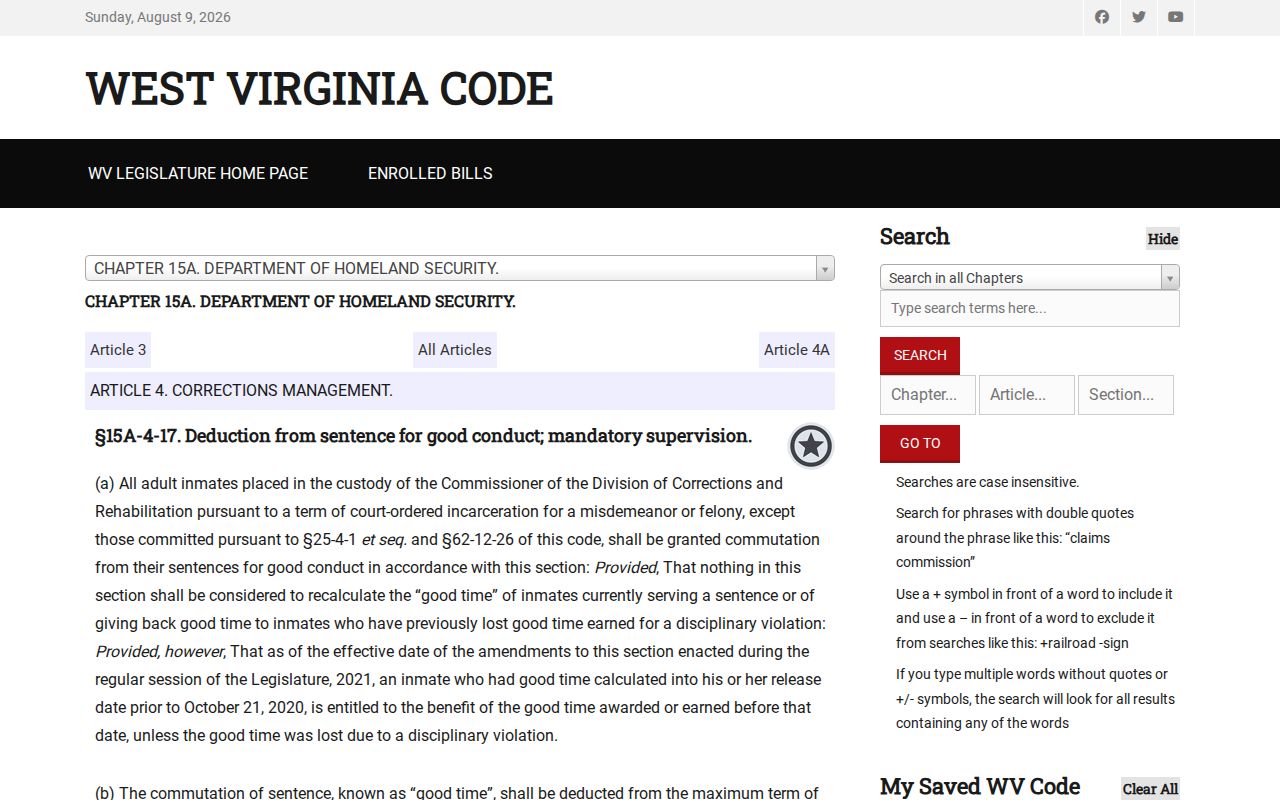
The captured law supports the day-for-day framework and its limits, while the person’s WVDCR time sheet supplies the actual computation.
Why Marion Release Dates Change
Policy 151.06 explains that WVDCR’s computer calculation begins with the maximum term and incorporates jail credit, good time, and street credit when applicable. When a material factor changes, staff issue an updated time sheet and update OIS. Saving the access date prevents an old figure from being mistaken for the current one.
| Factor | Effect on the date or outcome |
|---|---|
| Verified jail credit | Qualifying presentence days can reduce the remaining term. |
| Good-time forfeiture or restoration | Discipline can move the date later; approved restoration can move it back. |
| Resentencing or corrected order | A court change can alter the maximum term or credited time. |
| Consecutive sentences | Maximum terms are aggregated for the good-time computation. |
| Escape, interruption, or revocation | Time outside qualifying custody and a return to custody can require recalculation. |
| Detainer or receiving agency | The sentence date may remain, but the destination becomes another custodian rather than the community. |
| Parole decision | Eligibility, grant, denial, or deferral affects possible supervised release, not the computed final endpoint in the same way. |
A detainer is a request or legal basis for another authority to hold or receive the person. Thus, reaching the WVDCR date does not prove unrestricted release. The actual movement record should name the destination.
Marion Mandatory Supervision Dates
Physical release can occur before WVDCR authority ends. For specified offenses committed on or after July 1, 2013, §15A-4-17(k) uses one year of accumulated good time to create one year of mandatory post-release supervision when the calculated point arrives. Other felony cases may receive up to 180 days of court-ordered mandatory supervision under subsection (l).
This distinction changes how a future date should be described. The person may leave a prison but remain subject to WVDCR supervision. “Released” identifies the end of physical confinement in that facility. “Discharged” identifies the end of the sentence or supervision named in the record. Ask WVDCR which term applies.
Note: A minimum discharge calculation may mark physical release into supervision rather than the end of all WVDCR authority.
Marion Parole Eligibility Dates
Parole eligibility is another date that is often confused with release. The West Virginia Parole Board calls it PED, the point when an inmate becomes eligible for consideration. Under §62-12-13, the baseline is the minimum term of an indeterminate sentence or one-fourth of a definite term, with exceptions. Section 62-12-13a makes clear that eligibility creates no right to parole.
The Board may grant, deny, defer, or issue a contingent grant after assigned tasks. It also requires an approved home plan and specified record materials. A hearing calendar entry proves only that consideration was scheduled. The current monthly PDF replaces the prior file at the same URL, so it is not a lasting decision archive.
Do not add PED to a release calendar as though departure is set. Request the Board’s written decision, then confirm the actual WVDCR movement. A grant can still depend on conditions and processing.
Confirm Marion Actual Release
A future date should be checked again near the expected event. The Marion VINE inmate check can provide a custody-change notice for NCRJCF and WVDCR prisons. DCR intentionally withholds transfer calls while a person is moving and sends notice after arrival, so a quiet interval does not prove community release.
For the durable answer, ask WVDCR for existing records showing the admission, sentence-calculation revisions, actual release date and time if maintained, legal release type, and destination. Chapter 29B requires a response or notice of availability within five working days, subject to its rules, but that response period is not a promise that a large record production will be finished then.
If the court and WVDCR disagree, obtain the signed Marion order and the current DCR time sheet. A court order supplies legal authority. The custodian’s movement entry establishes what happened at the facility. Together they distinguish scheduled release, physical departure, transfer, and final discharge.
Keep a dated evidence log for each Marion release-date check. Record the system, query, matching identifiers, exact field label, displayed value, and screenshot filename. Classify each item as a scheduled sentence date, parole-eligibility point, court authority, notification event, or actual movement. Only the last category directly proves what the prison did. This prevents a copied future date, a hearing month, or a bond entry from being reported later as the time a person walked out.
Ask what each timestamp represents. An admission time marks intake. A signed-order time marks judicial action. A calculation date marks the sentence system’s work. A VINE timestamp marks a notification event. None automatically equals the point when staff finished identity checks, property handling, medication work, hold review, and physical departure. When exact timing matters, request the actual transaction and ask whether it reflects authorization, database entry, or departure.
Retention online is also unknown. WVDCR did not publish a promise that a discharged Marion person will remain visible for a set period. Loss of a public result cannot be converted into a release hour. Agency records and court orders may persist even when the public view changes, which is why the focused records request remains the final fallback.
Public Record Search
Sponsored Results